Reveal Hidden Cards
Hidden tableau cards are the main source of uncertainty. A move that flips a face-down card is usually stronger than a move that only tidies visible cards. More visible cards mean more ways to build sequences and reach foundations.
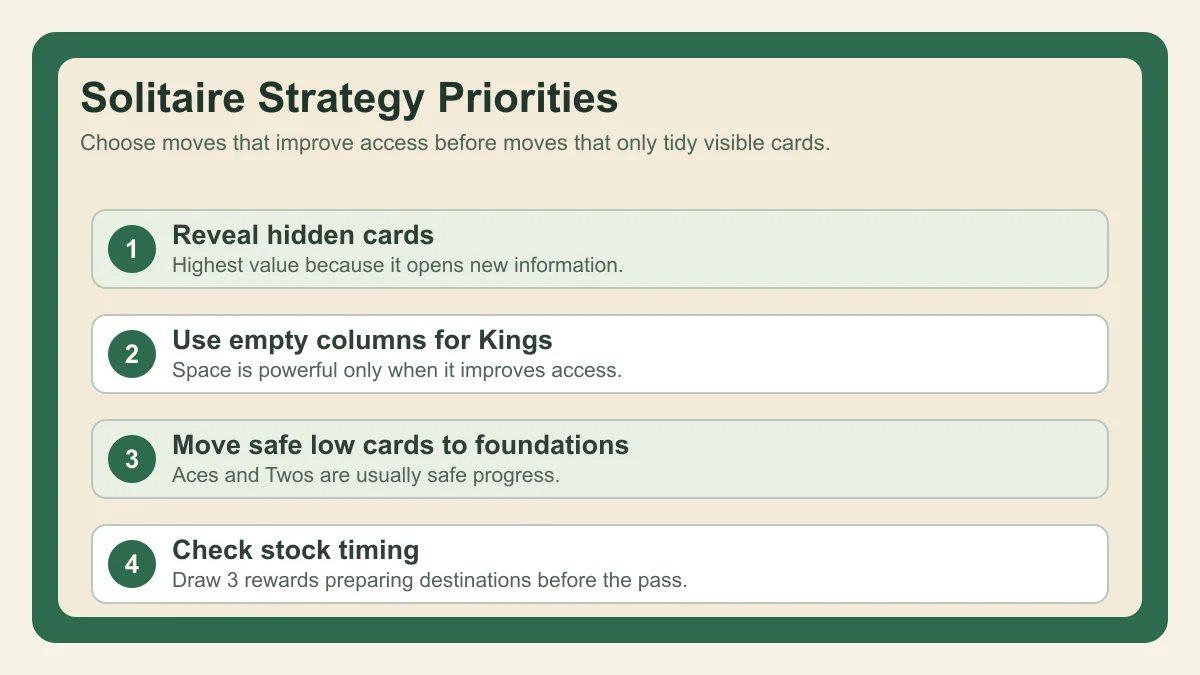
Not all reveals are equal. Revealing a card in a deep column can be more valuable than revealing a card in a shallow column because it may start a chain of additional moves. If two moves are available and only one flips a hidden card, start there unless the other move opens an empty column for a King.
Use visible moves to create reveal paths. A card may not reveal anything directly, but it may create a destination for the card that does. For example, moving a red 8 onto a black 9 may allow a black 7 to move, and that second move may uncover the card you need.
Use Empty Columns Carefully
An empty column is powerful because it can hold a King or a King-led sequence. Opening a column without a King can waste the opportunity. Before you clear a column, look for the King or sequence that will use it.
The best empty-column move usually does more than place a King. It moves a King-led sequence away from a covered column, reveals a hidden card, or creates another legal move. A lone King from the waste can be useful, but a tableau King that frees several cards may be stronger.
Do not fill empty space automatically. Pause and compare all available Kings. Which one uncovers information? Which one carries a useful sequence? Which one preserves color balance for the next ranks? Empty space is too valuable to spend without a plan.
Do Not Rush Every Foundation Move
Moving Aces and Twos to foundations is often safe. Higher cards require more judgment. If a card is still needed to support an alternating tableau sequence, moving it too early can block progress.
Foundation safety depends on the lower opposite-color cards. Before moving a middle rank, check whether the cards that would have used it are already placed or easy to reach. If not, keeping the card in the tableau may preserve a needed destination.
This does not mean foundation moves are bad. They clear cards, make progress, and can unblock the waste. The point is timing. A foundation move is strongest when it removes clutter without reducing tableau mobility.
Draw 1 Strategy
Draw 1 gives more stock access, so you can focus on tableau quality. Use the extra flexibility to reveal hidden cards and set up empty columns instead of cycling the stock without purpose.
Because every stock card appears individually, you have more chances to use the waste. That can hide weak tableau play. If you rely only on stock cards, the deep columns may remain covered too long. Treat Draw 1 as a learning mode for clean board development, not as permission to make random moves.
When a stock card is playable, ask whether it helps the tableau. A waste card that reveals a hidden card is excellent. A waste card that simply moves to another visible pile may be optional. If playing it blocks a better support card, leave it alone.
Draw 3 Strategy
Draw 3 is about order. Playing one waste card changes which cards appear next. Before moving the top waste card, check whether it exposes a more important card beneath it.
Track groups. You do not need to memorize the entire stock, but notice when useful cards appear together. If a needed Ace sits under two blocked cards, prepare destinations for those cards before the next pass. This turns the waste from a random stream into a sequence you can influence.
In Draw 3, tableau preparation matters more. A card in the waste is only useful if the board has a destination for it at the moment it appears. Revealing hidden cards and creating alternating-color destinations can make a later stock pass much stronger.
Practice With Undo
Undo is a learning tool. Try a line, see what it opens, and step back if the board gets worse. Over time you will learn which moves are productive and which only look busy.
Use undo deliberately. Do not just reverse mistakes after they happen. Test a move, inspect the new board, and ask what changed. Did it reveal a card? Did it create an empty column? Did it remove a needed support card? If the move did not improve access, try another line.
Restart is different from undo. Restart lets you replay the whole seed. That is useful when an early choice shapes the entire game. If you repeatedly lose the same deal, change one opening decision and compare the result.
Strategy Checklist
| Question | Strong answer |
|---|---|
| Does this move reveal a hidden card? | Usually worth considering first |
| Does it create or use an empty column? | Strong when a King-led sequence benefits |
| Does it move a safe low card to a foundation? | Often good for Aces and Twos |
| Does it only rearrange visible cards? | Look for a stronger move first |
| Does it improve the next stock pass? | Important in Draw 3 |
This checklist prevents busy moves. A board can have several legal choices, but only one or two may improve access. If a move does not pass any of these tests, it may be better to draw, wait, or use undo to test another line.
Advanced Position Reading
Look at column depth. A long covered column is a risk because important cards may be buried there. A shallow column is an opportunity because it may clear and create space. The best move often connects those two facts: use a shallow column to open space, then use that space to attack a deeper column.
Look at color balance. If many black cards need red destinations and few red cards are available, preserve the red cards you have. If a move sends a red card to the foundation and removes the only destination for a black card, it may be premature.
Look at low-card access. Foundations cannot grow without Aces, Twos, and Threes. If a low card is buried, prioritize the column above it. If low cards are available but unsupported by foundations, move the needed Aces first.
When to Take a Risk
Sometimes every safe move is exhausted. In those positions, a risk is reasonable when it has a clear upside. Moving a support card to the foundation may be worth it if it uncovers a deep hidden card. Filling an empty column with a lone King may be correct if it opens another column. Drawing through the stock may be right if no tableau move changes access.
The key is to choose a risk you can evaluate. After the move, inspect the result. If it makes the board worse and undo is available, step back. If it opens new information, continue and adjust the plan.
Common Strategy Traps
One trap is chasing neat columns. A clean-looking tableau is not always a strong tableau. If the move does not reveal hidden cards, create space, or improve foundation timing, it may only make the board look organized.
Another trap is moving too quickly through the stock. The waste can help only when the tableau has destinations. If several draws pass without progress, stop and look for a buried card, an empty-column plan, or a safer foundation choice.
The last trap is treating hints as commands. A hint can identify a useful move, but you should still ask why it helps. The strongest players use hints to learn priorities, not to avoid decisions.
Measuring Improvement
Better play does not always mean winning every random deal. Some deals are blocked. Improvement means revealing more hidden cards before the board stalls, wasting fewer empty columns, and understanding why a seed failed. Track whether your losses happen with many hidden cards still covered or after most of the board was opened. The first case points to reveal problems; the second may be a difficult deal or a stock-order issue.
Review one finished game before starting the next. Ask which move opened the deepest column, which move wasted space, and whether a foundation card left too early. That short review turns casual play into practice without making the session feel formal.