Solitaire Setup
Classic Solitaire starts with seven tableau columns. Deal one card to the first column, two to the second, three to the third, and continue until the seventh column has seven cards. Only the top card of each column is face up. The remaining cards form the stock. Four empty foundation spaces sit above the tableau.
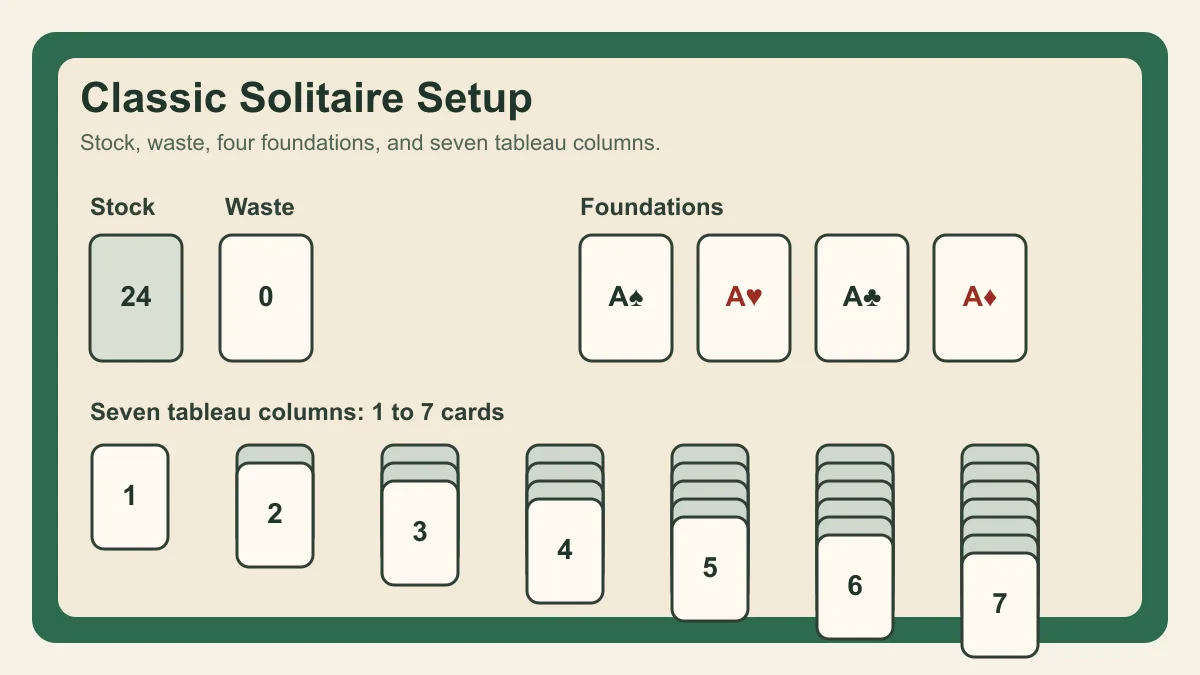
This setup creates the central tension of Klondike: you can see enough to make decisions, but many cards are hidden. Your first priority is usually to reveal those hidden cards.
| Column | Cards dealt | Face-up cards at start |
|---|---|---|
| 1 | 1 | 1 |
| 2 | 2 | 1 |
| 3 | 3 | 1 |
| 4 | 4 | 1 |
| 5 | 5 | 1 |
| 6 | 6 | 1 |
| 7 | 7 | 1 |
The layout can be read from left to right. The left side has fewer cards and often clears faster. The right side has deeper stacks and usually hides more important information. A beginner mistake is to focus only on the short columns because they feel easier. In most games, the deeper covered columns deserve attention because each reveal changes more of the board.
Goal of the Game
The goal is to move every card to the four foundations. Each foundation belongs to one suit and starts with an Ace. After the Ace comes the Two of the same suit, then the Three, and so on through the King.
The foundations are the finish line, but they are not always the best immediate destination. Moving an Ace is almost always safe because it starts a foundation. Moving a Two is usually safe once the Ace is in place. Higher cards need more judgment. A red 6, for example, may be needed in the tableau so a black 5 can move and reveal a hidden card. If the red 6 leaves too early, the black 5 may stay blocked.
Think of the game as an access puzzle. The foundations show progress, but the tableau creates access. Winning depends on opening hidden cards, keeping enough destinations available, and using the stock at the right time.
Basic Solitaire Rules
Tableau cards build downward by alternating color. You can place a black 7 on a red 8, or a red 4 on a black 5. A legal face-up sequence can move together. Empty tableau columns accept Kings. The stock feeds the waste pile, and the top waste card can move when legal.
The alternating-color rule matters because it creates dependencies. A red card needs a black card one rank higher. A black card needs a red card one rank higher. When you choose between two legal moves, check which move creates the better destination for the next rank down. A move that looks small can be valuable if it creates a place for a buried card.
The stock and waste add timing. In Draw 1, each card appears alone. In Draw 3, three cards appear as a group, but only the top card is playable. The tableau rules stay the same in both modes, but the stock rhythm changes how patient you need to be.
Legal Moves
Legal moves include moving an Ace to an empty foundation, moving the next suited rank to a foundation, moving a card or sequence onto an opposite-color card one rank higher, moving a King into an empty tableau column, and drawing from the stock.
| Move type | Legal when | Why it helps |
|---|---|---|
| Tableau to tableau | Card colors alternate and ranks descend by one | Reveals hidden cards and builds sequences |
| Tableau to foundation | Card is next in suit order | Moves toward the win condition |
| Waste to tableau | Waste card has a legal destination | Converts stock access into board progress |
| Waste to foundation | Waste card is next in suit order | Clears useful low cards |
| King to empty column | Column is empty and the moved card is a King | Creates space for longer sequences |
Not every legal move is equally good. A move that reveals a card is usually stronger than a move that only rearranges visible cards. A move that creates an empty column is strong when a King can use it. A move to the foundation is strong when it does not remove a card needed in the tableau.
How to Win
Winning depends on access. Reveal hidden tableau cards, keep useful low cards available, and open columns at the right time. A move that sends a card to the foundation is good only if it does not block a needed tableau build.
Start by scanning all face-up cards. Look for Aces, moves that reveal hidden cards, and columns that can be cleared for Kings. If no tableau move improves access, draw from the stock. When a stock card becomes playable, ask whether it reveals something or supports a future reveal. If it only moves sideways, you may be better off waiting.
Empty columns should be treated as scarce resources. A King with a long sequence can transform a board because it moves many cards away from a covered column. A lone King may be less useful if it fills the space without opening anything. Before placing a King, check which hidden card or sequence the move will help uncover.
Undo helps you learn. Try a move, inspect the result, and step back if it clearly reduces options. The point is not to memorize one solution. The point is to see why a move improved or weakened the position. Over time, you will recognize productive moves faster.
Common Beginner Mistakes
The most common mistake is moving visible cards without revealing anything. Another is opening an empty column too early and then having no King to use it. Beginners also move every card to the foundation immediately, which can remove cards needed to shift tableau sequences.
A second common mistake is drawing through the stock repeatedly while ignoring a blocked tableau. If several stock passes do not help, the board probably needs a different reveal or a better empty-column plan. Stock cards are useful only when the tableau has destinations for them.
Players also miss sequence moves. If several face-up cards are already in legal alternating order, the entire sequence can move together. Moving a sequence can uncover a face-down card without breaking the order. This is often stronger than moving only the bottom card.
Another mistake is judging the board too quickly. A position can look stuck when one hidden card reveal would change everything. Scan each column from top to bottom, check the waste, and look at foundation safety before giving up.
Beginner Practice Plan
Start with Draw 1 because the stock is easier to understand. Play slowly and say the purpose of each move before making it: reveal a card, build a foundation, open a column, or prepare a destination. If you cannot name the purpose, the move may be unnecessary.
After a few games, replay the same seed with fewer undos. Try to remember which early move opened the deepest column. Then switch to Draw 3 and notice how the waste order changes your priorities. The rules are familiar, but the timing becomes stricter.
Use hints when you are stuck, not after every turn. A hint is most useful when you compare it with your own idea. If the hint chooses a reveal and you planned a foundation move, ask why access might matter more. That comparison is where learning happens.
Quick Reference
Start with the tableau, not the stock. Move Aces when they appear. Reveal hidden cards whenever a safe move allows it. Save empty columns for Kings. Use the waste when it creates a reveal, a foundation move, or a destination for a buried card. If the board feels stuck, undo the last busy move and look for a move that changes access instead of only changing appearance.
This reference is intentionally short because the best way to learn is to play a seed, restart it, and improve the first few choices.
If one rule feels unclear, use the related setup and rules pages before returning to the playable board.
Then replay the same seed once.