Basic Solitaire Rules
Classic Solitaire uses a standard deck, seven tableau columns, a stock, a waste pile, and four foundations. The tableau builds downward by alternating color. The foundations build upward by suit.
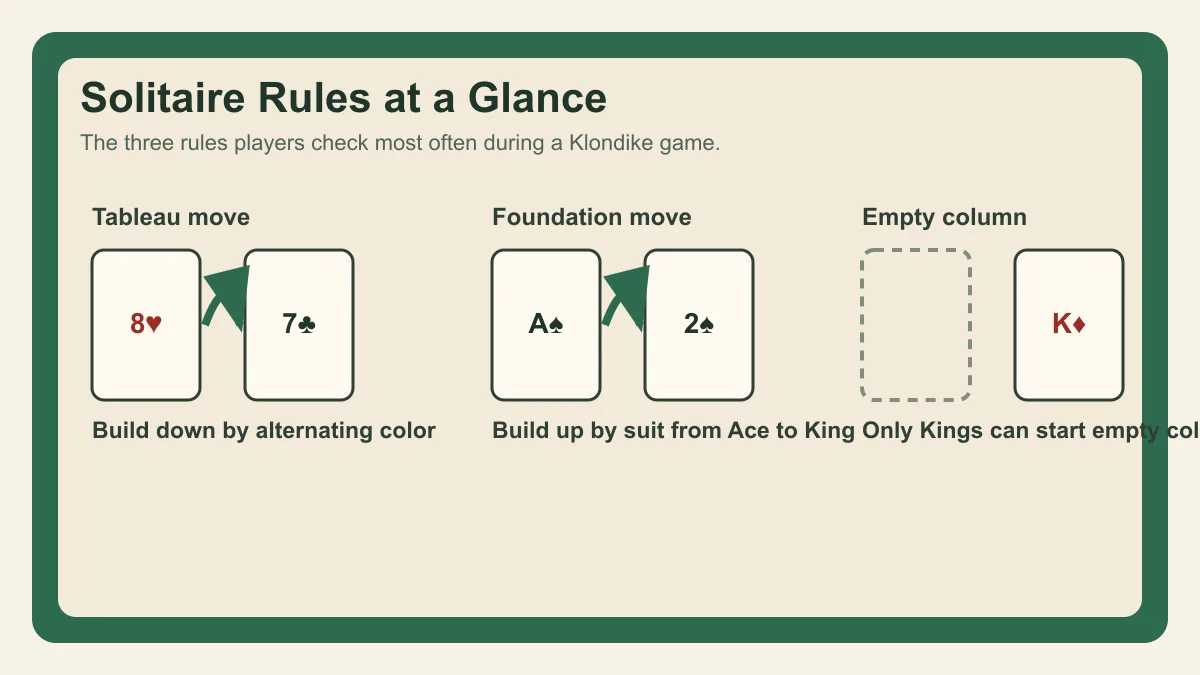
The rules are simple enough to learn in a few minutes, but they create many small decisions. A legal move is allowed by the rules. A good move improves access, protects future moves, or advances a foundation without weakening the tableau. This distinction is important because beginners often lose by making legal moves that do not help.
| Area | What it does | Main restriction |
|---|---|---|
| Tableau | Main work area with seven columns | Builds down by alternating color |
| Stock | Holds undealt cards | Draws one or three cards depending on mode |
| Waste | Holds drawn stock cards | Only the top waste card is playable |
| Foundations | Final suit piles | Build up from Ace to King |
The objective is always the same: move every card to the foundations. The path depends on revealing hidden tableau cards, managing the waste, and using empty columns for Kings.
Tableau Rules
A card can move onto a card of the opposite color and one rank higher. For example, a red 6 can move onto a black 7. Face-up sequences can move together when every card in the sequence follows this rule.
Only face-up cards are available. A face-down card cannot be selected until every card above it has moved away. When a hidden card becomes exposed, it flips face up and may create new moves. This is why tableau reveals are often more valuable than simple rearrangements.
Sequences are important. If a black Jack, red 10, and black 9 are already stacked in order, they can move together onto a red Queen. Moving the whole sequence may uncover a hidden card while preserving a legal build. Breaking the sequence is usually unnecessary unless it reveals something more valuable.
Empty tableau columns have a special rule: only a King or a sequence starting with a King can move there. This rule makes Kings central to the game. Clearing a column before you have a King available may not help immediately, while clearing a column at the right moment can unlock a deep stack.
Foundation Rules
Each foundation starts with an Ace. After that, only the next rank of the same suit can move there. The Hearts foundation accepts Ace of Hearts, Two of Hearts, Three of Hearts, and so on.
Foundation moves are irreversible in some physical-rule versions, while many digital versions allow cards to move back when legal. Even when moving back is allowed, foundation timing still matters. A high card may support a tableau sequence, so moving it up too early can remove a needed destination.
A practical safety check is to compare lower opposite-color cards. If moving a red 7 to the foundation leaves no red 7 available for black 6 cards, the move may be risky. If the lower cards are already placed or accessible, the foundation move is safer.
Aces and Twos are normally safe. They begin foundation progress and rarely serve as important tableau supports. Middle ranks require more attention because they connect many sequences.
Stock and Waste Rules
The stock contains undealt cards. Drawing moves cards to the waste. In Draw 1, one card appears. In Draw 3, three cards appear, but only the top waste card is playable.
In Draw 1, every stock card becomes available in order. This makes the mode easier and more forgiving. In Draw 3, cards are grouped, and a useful card may be blocked by cards above it. Playing one waste card can expose another, so timing matters.
The waste top card can move to the tableau if it follows the alternating-color descending rule. It can move to a foundation if it is the next card of that suit. If neither move is useful, drawing again may be correct, but repeated stock cycling without tableau progress is a warning sign.
Some rulesets limit the number of stock redeals. This site focuses on browser-friendly casual play, so the controls prioritize immediate play, undo, and restart. If you are comparing scores with another ruleset, check whether redeals and draw mode match.
Empty Column Rules
Only Kings can move into empty tableau columns. A sequence can also move into an empty column if the first card is a King.
The empty-column rule is one of the easiest rules to remember and one of the easiest to misuse. Space is powerful, but only with the right King. A King that reveals a hidden card is usually stronger than a King from the waste that simply fills the space. A King carrying a long sequence can be stronger than a lone King because it moves more cards away from another column.
If several Kings are available, compare what each move opens. Does it reveal a hidden card? Does it move a long legal sequence? Does it create another empty column later? Choose the King that increases access rather than the one that looks convenient.
Winning Rules
You win when every card is in the foundations. A game may be blocked before that point if key cards are buried or unreachable, especially in random Draw 3 deals.
Not every random deal is guaranteed to be solvable. A winnable label should only be used when a seed has been verified by a solver or known solution. Random deals are still valuable because they create variety, but they should not be described as guaranteed.
The win state is reached when all four foundations contain complete Ace-to-King suit sequences. The tableau, stock, and waste are empty or irrelevant at that point because every card has reached its final pile.
Rule Examples
If the tableau shows a red Queen and a black Jack, the Jack can move onto the Queen. If a red 10 sits on the black Jack, both cards can move together as a legal sequence. If the move uncovers a face-down card, that card flips and may immediately become playable.
If the Hearts foundation has Ace, Two, and Three, the Four of Hearts can move there. The Five of Hearts cannot move until the Four is placed. A Four of Diamonds cannot move to that Hearts foundation because foundations are separated by suit.
If a tableau column is empty and a black King is available, the King can move there. A Queen cannot move into the empty column, even if it has a legal sequence under it. A sequence beginning with a King can move because the first card satisfies the empty-column rule.
Rules Checklist
Before making a move, check four questions. Does the move follow rank and color rules? Does it reveal a hidden card or improve access? Does it preserve a needed destination? Does it use empty-column space wisely? If the answer is only that the move is legal, look for a stronger option first.
Draw Mode Differences
Draw mode does not change tableau rules, foundation rules, or empty-column rules. It only changes how stock cards enter the waste. Draw 1 reveals one card at a time, which gives the player more direct access. Draw 3 reveals three cards at a time, with only the top card playable, which makes waste order more important.
For learning, Draw 1 is clearer. For a stricter classic challenge, Draw 3 is better. The important rule is to compare games only when the draw mode matches, because the same seed can play very differently under each mode.
Digital Rule Notes
Browser versions often add undo, hints, restart, seed display, and local saves. These tools do not change the underlying rules; they make the game easier to study and more convenient to resume. Undo is especially useful for learning why a legal move was weak.
Full-screen mode, dark mode, high contrast, and large cards are accessibility settings. They should never alter card order, legal moves, or the win condition.
When checking a digital implementation, test the same rule through both drag and tap controls. A legal move should work through either input style, while an illegal move should be rejected consistently. That keeps the interface from changing the practical rules of the game.
Consistent rejection is as important as successful movement because it teaches the rule.